|
Hi everyone,
This is the last newsletter of this strange and sad year. This newsletter will be a bit special, and dedicated to re:Invent. I focus on serverless announcements and sessions, but there is much more...
I hope you are all healthy and I wish you a Merry Christmas and joy for you and your dears. See you next year!
Jerome
|
|
How AWS is computing the future of the cloud
|
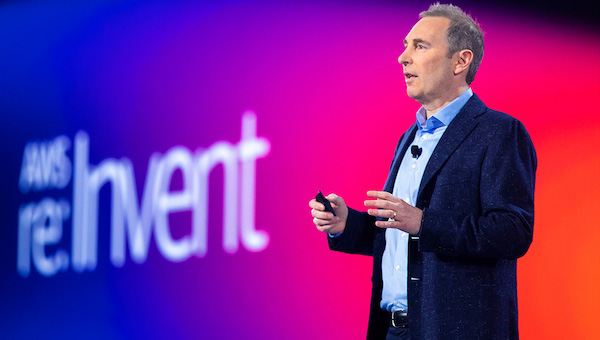
In this interview, Andy Jassy states that half of the new applications that Amazon built in 2020 were built on Lambda and bets the next generation of developers will grow up building serverless applications. I do agree, not because he's my boss, but because serverless really empowers developers and is much more productive.
And if you missed his keynote, here it is and the list of announcements is here. Once again, a lot of new features and services.
|
|
|
Amazon S3 Update – Strong Read-After-Write Consistency
|
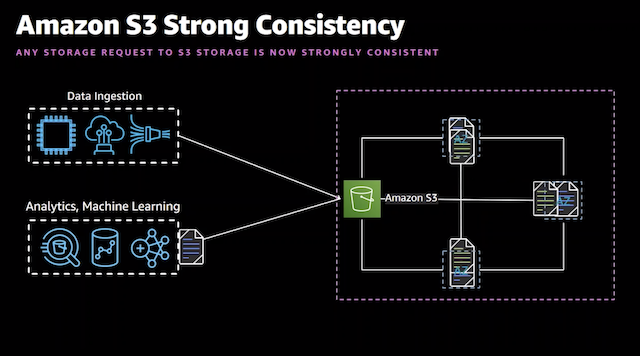
This is probably the most incredible announcement of this re:Invent, from my point of view. If you know the CAP theorem, then you know what I mean. This theorem says that in a distributed system, you can only have two out of three characteristics (Consistency, Availability, Partition tolerance).
S3 is a distributed object storage service, and generally has 6 or more replications of the same object across all Availability Zones within a region. And until now, S3 was offering eventual consistency for read after write.
But now, you have strong consistency, without losing performance, durability or reliability, and for the same price as before. Just amazing!
And if you are interested in other S3 updates, look at this session.
|
|
| New for AWS Lambda – 1ms Billing Granularity Adds Cost Savings |
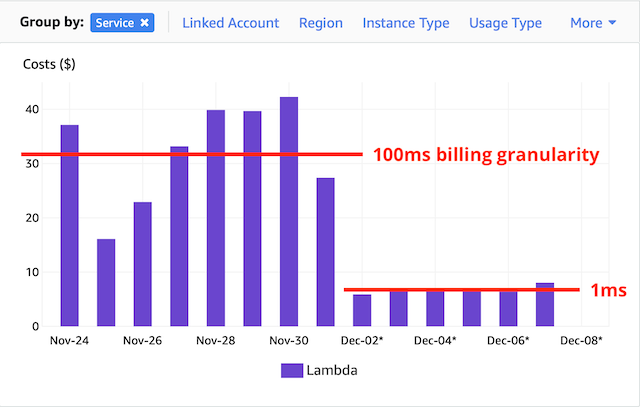
Another great news for all Lambda users, and a great argument for everyone yelling about vendor lock-in and cost-increase. Lambda is now billed per millisecond instead of 100 ms increments. It probably won't be a huge drop in most bills but noticeable if your function is invoked millions of times per month.
For example, let's say your average execution time is 140ms and your function is invoked 10 million times a month with 512 MB. Without any action from your side, you instantaneously reduce your bill from $16.67 to $13.67. As I said, it's not that huge but it's a nice gift for Christmas.
$3 for 10 millions invocation: is it worth investing time to optimize your function. Probably not, and this is also the opinion of Yan Cui in its article: Your time is much more expensive than your Lambda function...
|
|
|
New for AWS Lambda – Container Image Support
|

Today, many companies are leveraging containers to package and deploy their applications, but until this announcement, it was not possible with Lambda. Now, you can leverage the exact same tooling to build your images for any container-based environment and Lambda.
As I mentioned in my LinkedIn post, it is important to note this is only a way to package your function, replacing the zip file. Everything else remains the same: stateless, event-driven, 15 minutes timeout, ... not to confuse with Fargate.
With this news, comes another one: the ability to create images up to 10GB vs 250MB for zip files. Many great posts have been writen since the announcement: James Beswick on ACloudGuru,
Yan Cui on Lumigo,
or Philipp Schmid...
|
|
| AWS Lambda Functions with Up to 10 GB of Memory and 6 vCPUs |
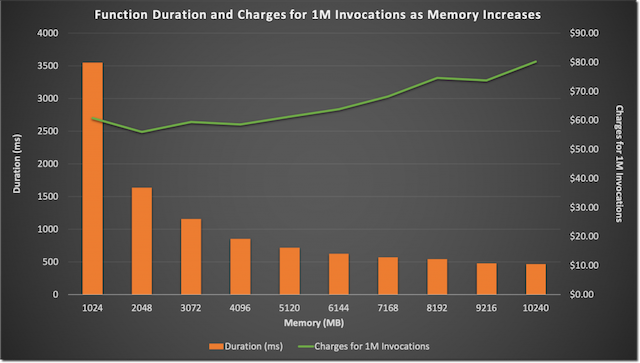
When AWS announced the ability to use EFS within a Lambda function, it opened new opportunities, mainly around machine learning. But machine learning is generally resource intensive! This update will definitely help, and also open up new uses cases: image or video manipulation for example.
Look at this blog post which provides some benchmark (cost / performance) while using ffmpeg.
I mentioned it already in a previous newsletter, use the aws-lambda-power-tuning to find the best ratio performance/cost, depending on the properties of your function (if it can leverage multiple cores).
|
|
|
Introducing the next version of Amazon Aurora Serverless in preview
|
|
Aurora Serverless (v1) has been announced in 2018, so quite recently... And today, AWS announces a v2 (in preview)! This 2nd version brings some interesting updates: the main one is its ability to scale up and down more quickly and more fine grained than its predecessor, thus allowing it to match the load more precisely and reducing costs.
Jeremy Daly performed some tests and provides an interesting analysis. And Yan Cui gives some answers to frequently asked questions.
|
|
re:Invent 2020: my selection of sessions
|
This year, re:Invent was online and free for everyone. If you didn't have the chance and the time to watch it, all sessions are available on demand. But to help you choose, here is my top 10 (without any special order):
- Amazon API Gateway HTTP APIs: Beyond the proxy, great presentation of HTTP APIs from Eric Johnson (lvl 400)
- How LEGO.com accelerates innovation with serverless, as always nice customer feedback from Sheen Brisals, architect at LEGO (lvl 300)
- AXA: Rearchitecting with serverless to accelerate innovation, another great customer feedback (lvl 200+)
- Is your serverless application well-architected?, covers the serverless well-architected lens in 30 minutes, really good! (lvl 300)
- Scalable serverless event-driven architectures with SNS, SQS & Lambda, a lot of detailed information about SNS and SQS (lvl 300)
- Building revolutionary applications the serverless way, from Ajay Nair, AWS Lambda Director, just that! (lvl 300)
- Construire des workflows complexes de calcul avec AWS Step Functions et AWS Fargate, french session which provides a deep dive on Step Functions. (lvl 300+)
- Deep dive into AWS Lambda security: Function isolation, this one is really techy (lvl 400), really interesting to discover Lambda under the hood.
- Building event-driven applications with Amazon EventBridge. Have I ever told you I love Eventbridge? Very complete video, in 30 minutes! (lvl 300+)
- Decoupling serverless workloads with Amazon EventBridge. Yes I really love it. And I'm also a fan of James Beswick! (lvl 300-)
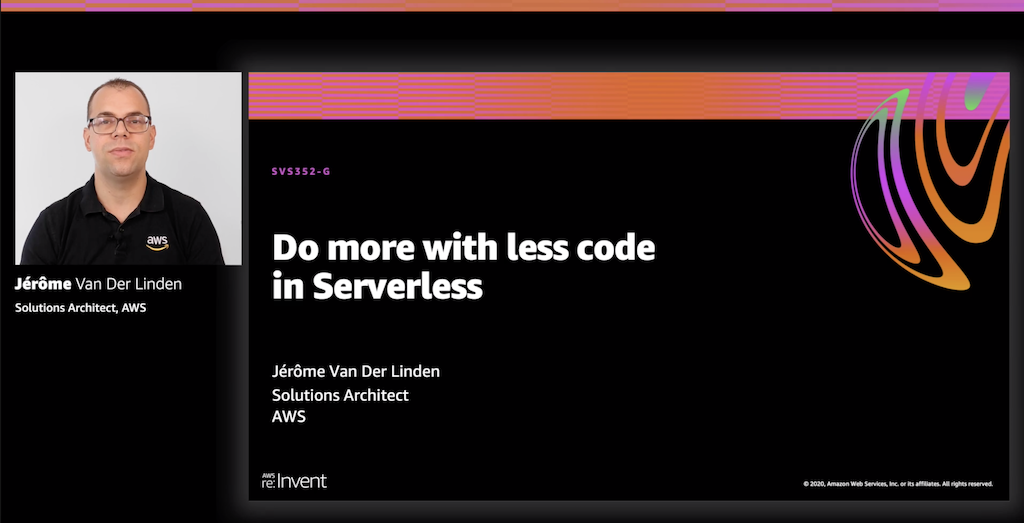
And as a bonus, you can also find my session here: Faire plus avec moins de code en Serverless, in french, that explains how to leverage serverless services to reduce the amount of code and number of lambda functions (lvl 300):
Of course, there are many other great sessions, on serverless and other topics: just go to the catalog and search for what you want.
|
|
You are receiving this email because you subscribed via Meetup
Want to be removed?
No problem, click here to manage your notifications.
|
|
|
|


